James Barr - A Line in the Sand (2011).
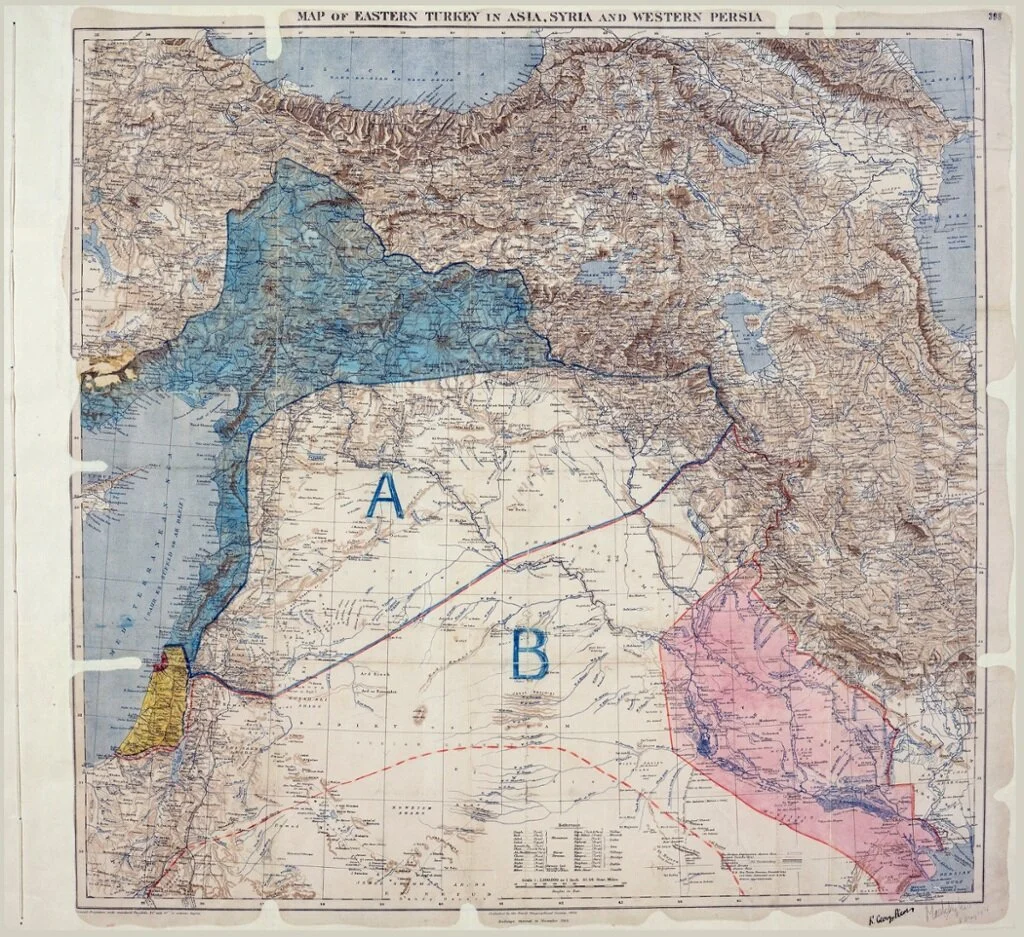
My one liner: Viewed through the lens of the mutual back-stabbing between Britain and France in the first half of the 20th Century, the origins of the current strife in the Middle East become clearer. An "infographic review".
Take the following quotes referring to a political debate in Britain about her presence in Mesopotamia (now Iraq), and you come to realise how historical cycles repeat themselves:
"However, by now the terms of the oil-sharing arrangement that Britain had reached with France...had become public and were attracting controversy, particularly in the United States which had been excluded from the deal...During the 23 June debate...[Prime Minister] Asquith systematically tore into Churchill's figures to demonstrate that the costs of Britain's presence were still unclear, and questioned the assumption that Britain would ultimately reap a divided from its mandate. He attacked Lloyd George's root interest in the country, for its oil, as a 'fundamental violation' of the League of Nations covenant signed by Britain."
"At the beginning of July the small British garrison in the town of Rumaythah on the railway 150 miles south of Baghdad was attacked by thousands of well-armed and disciplined insurgents...Led by the nationalists and backed by the Shia's powerful religious leaders, the rebellion quickly spread among the tribes of the fertile Euphrates flood plain...The tribesmen cut the railway in several places, and within days much of the areas between Rumaythah and Diwaniyah...was in revolt."
Author James Barr has forensically analysed government and diplomatic papers up to the immediate post-war period to present a well-narrated account of how the two declining colonial powers Britain and France managed to undermine each other's interest in the region.
An alternative style adopted for this review.
I have taken inspiration from the book "Information is Beautiful" by David McCandless (highly recommended) to create a few charts (nowadays known as "infographics", I believe) that show the interplay between the two powers in the region, and the timelines by which some of the modern states were created.
The charts are my own creation based on my interpretation of the book, and of course do not capture much nuance. But hopefully they give a flavour of the extensive ground and material covered by the author. Apologies to the author (and, no doubt, others more knowledgeable than me) for inaccuracies.
Syria. 9 September 1919. David Lloyd-George, British Prime Minister: "We could keep faith both with the French and the Arabs, if we were to clear out of Syria, handing our military posts there to the French, and at the same time, clear out of Damascus, Homs, Hama and Aleppo, handing them over to Feisal [for a short period King of independent Greater Syria]. If the French then got into trouble with Feisal it would not be our fault."
"On 27 May [1943], fighting erupted in Homs and Hama, the two main cities between Damascus and Aleppo. In Hama a dispute between the French and the Syrian gendarmes about who controlled the railway station escalated. After the Syrians ambushed a French relief column outside the town, capturing artillery and armoured cars, the French retaliated by mortaring, machine-gunning the town. Eighty people died."
Lebanon. "In June 1941 British and Free French forces invaded Syria and Lebanon to stop the Vichy administration providing Germany with a springboard for an offensive against Suez. After the Vichy French surrendered a month later the British government entrusted the government of Lebanon and Syria to the Free French. When that move caused Arab anger British officials decided that the best way to divert attention from Palestine was to help both Syria and Lebanon gain their independence at French expense. With significant British assistance the Lebanese did so in 1943."
Mesopotamia (Iraq). "Once the British government had decided that control of Northern Iraq mattered more than the question of who was allowed to join the Turkish Petroleum Company, [Chief Executive, John] Cadman went to the United States later in 1922 to hammer out a provisional agreement that offered the Americans participation in the company. That done American criticism magically evaporated, the Mosul dispute was eventually resolved in 1926 and the deal was signed in 1928. By its terms, four companies - Anglo Persian, Royal Dutch Shell, the French state-owned Compagnie Française des Pétroles and the Near East Development Corporation which represented the various US companies' intrests) each had an equal stake of 23.75 per cent in the TPC. 'Mr Five Percent', Calouste Gulbenkian, who had set up the company, retained the remainder."
Palestine (Israel). The Balfour Declaration 1917 (Arthur Balfour, British Foreign Secretary): "His Majesty's Government view with favour the establishment of a national home for the Jewish people, and will use their best endeavours to facilitate the achievement of this object, it being clearly understood that nothing shall prejudice the civil and religious rights of existing non-Jewish communities in Palestine, or the rights and political status enjoyed by Jews in any other country."
From the author: "On 10 November [1945], [Georges] Bidault [French Foreign Minister] quietly told David Ben-Gurion [Zionist leader and subsequently first Prime Minister of Israel] that France would support the Zionist cause. Eighteen months earlier Ben-Gurion had offered up the hope in public that, after the war, the Jews would find that a rejuvenated France would 'have an understanding attitude towards us'. That prayer had now been answered. It was not long before France's grand policy of covert support for the Zionists would emerge. "
There is no wikipedia page for this book. The author's homepage is here